
Gather some blooms with a mille-feuille of fragrant petals, let the flowers tumble into a vintage jug or two- then settle back and let the flowers do the talking…


Gather some blooms with a mille-feuille of fragrant petals, let the flowers tumble into a vintage jug or two- then settle back and let the flowers do the talking…

Have you ever needed to pull together a simple supper or starter which was sophisticated and subtle, but which took no time at all to fix up? Because if so, this recipe is for you! It uses store cupboard ingredients, is quick and easy to make, is fragrant with lemongrass, spiced with chilli and freezes like a dream. It’s also vegetarian and a dish which brings you sunshine all the year round.
Sybil Kapoor’s Sweet corn, Lemongrass and Chilli Soup- serves 6
4 tablespoons oil
6 stems of lemongrass, finely chopped
I red chilli, finely sliced
2 garlic cloves, roughly chopped
2 onions roughly diced
4 stems celery, roughly diced
1 kg frozen corn kernels
Salt and pepper
200g Crème fraiche
Coriander leaves to serve
Method

Strong, sturdy and romantically inclined, this table tugged at my heart-strings on first sight. Made from green oak and carved with lines from my favourite poem, The Eve of St Agnes’ by Keats and made by Marnie Moyle, it is one of my most prized possessions.
Standing out in all weathers, twisting and shrinking with time it ages naturally and with great grace. It’s perfectly carved edges are hand hewn with lines from one of the stanzas of the poem which focuses on the superstition that by the performance of certain rites on St Agnes’ Eve (January 20th) a girl might obtain a vision of her future husband. The poem is a series of pictures “glowing and gorgeous” as Leigh Hunt said “with the colours of romance.”
And still she slept an azure-lidded sleep,
In blanched linen, smooth and lavender’d
While he from forth the closet brought a heap
Of candied apple, quince, and plum, and gourd;
With jellies soother than the creamy curd,
And lucent syrops, tinct with cinnamon;
Manna and dates, in argosy transferr’d
From Fez; and spiced dainties, every one’
From silken Samaracan to cedar’d Lebanon.
Can you see now how easy it was for me to fall in love?


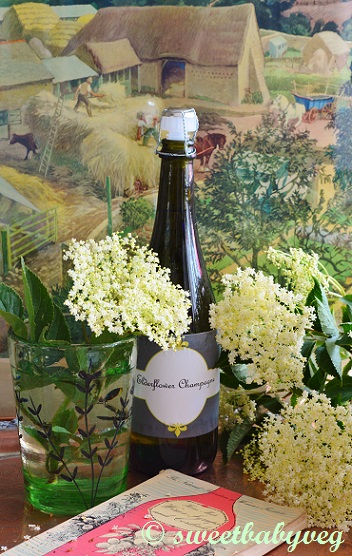
“Get in touch with your inner hippy”
The hedgerows in Devon are full of the scent of Elderflower blooms, those magical mille fiori blossoms which speak of Summer and blue skies. Time to make Elderflower Champagne! It’s easy to make and requires just a few simple ingredients. Go on; get in touch with your inner hippy this weekend as you forage in the hedgerows. It won’t be long before those corks are popping!
ELDERFLOWER CHAMPAGNE
6-7 Elderflower heads in full bloom
1 gallon (8 pints) cold water
1 1/2lbs sugar
2 tblsp white wine vinegar
Juice of 1 lemon
METHOD
Have a great weekend!
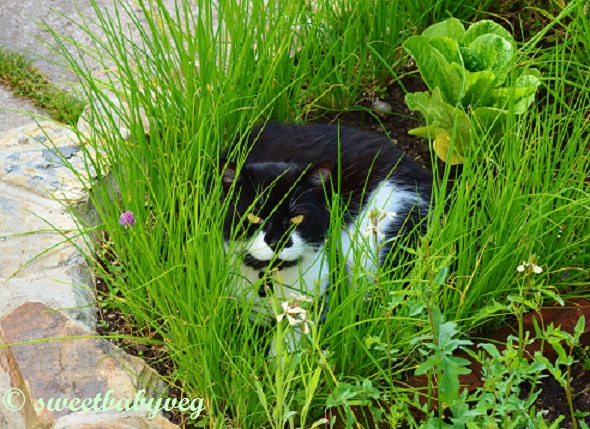
I like it here, it’s like a cosy little nest.

But this spiky grass is getting on my nerves.
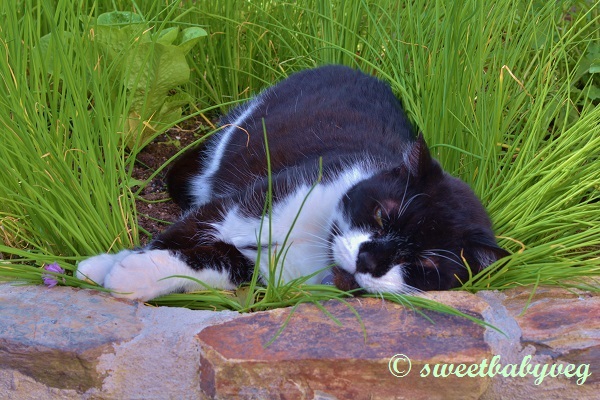
Ah……..that’s better!

It is 5 a.m and I am hanging out with the Sparrows under the eaves of my house. I want to see the view that this friendly colony of birds have from their terraced eyrie, so I climb as high as I dare and hang out of the window. Their nests are inches above my head and their view of the garden is ravishing!
This adventurous idea of mine to spend time with these colonial, social birds is accompanied by much cheeping and chirruping as the Sparrows go about their daily tasks. Totally unperturbed by my presence, they are constantly on the move, swooping back and forth down to the garden to get food for their young. And I realise how accustomed they must be to the daily rhythms of my gardening life, always flying around and above me as I go about my tasks. They must oversee the watering, weeding, planting and the filling of their feeders with nuts and seed, just like some winged garden caretakers.
With my arms aching now from all the reaching and thoughts of flying, I take some photos, capturing a glimpse of the birds-eye view of the habitat we share. These pictures will be the most perfect memento of how my life is entwined with these special, cheery little birds who help to make my garden feel so special.
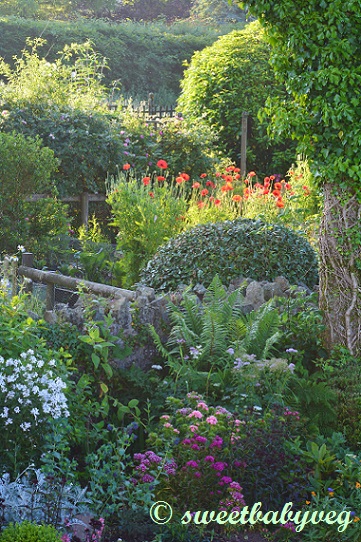
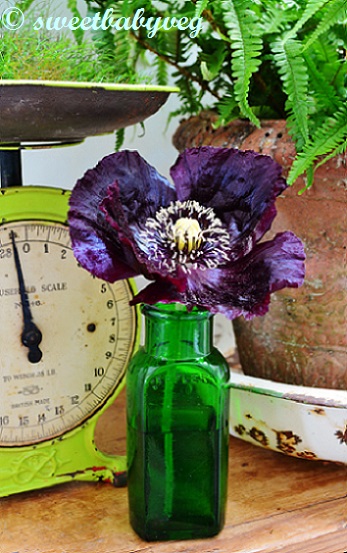
My first ‘Black Beauty’ Poppy blooms and my cries of excitement must have woken the whole neighbourhood! I pick it in celebration of its dark, sumptuous, movie-star glamour and to bring a shot of drama to my dining table for a special supper for friends tonight!
HAVE A GREAT WEEKEND!
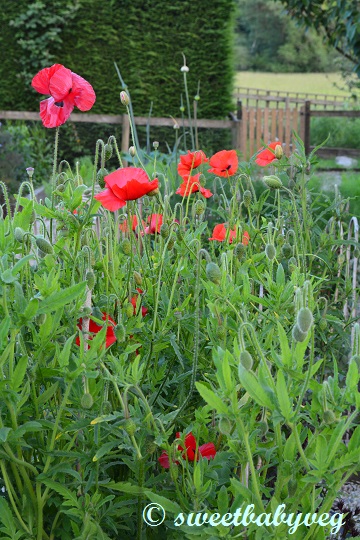
Sturdy, stocky and weather hardened; Farmer Crocker gives me a wave as I pass his Farm gate. Plump and rosy hued heathers bloom where he stands and a thought crosses my mind- do we become to look like our plants in the way that we become to look like our animals? Farmers in my village whose families have worked the land for generations know exactly what will grow and what plants have adapted to this windswept, wet location and they plant low, tough hardy plants which will withstand the wind and weather.
Where as I (a new-comer of only 30 years), still plant as though I had never listened to good advice. It I were to be a flower I want to be a willowy Delphinium with petals the colour of a Summer sky, or a peppery scented Lupin with blue and white pods with colours borrowed from a willow pattern plate. And I plant these flowers each year in the hope that the wind will never rise above a fragrant, soft and gentle breeze.
So each Summer, when a wind blows in from the South West with gusts strong enough to break the glass in a metal framed greenhouse I am usually to be found, tear stained and forlorn, tying up my delicate flowers to stakes. If you had visited me last weekend that is exactly what you would have seen. An angry wind strong enough to lift the door into the roof space and tear the roofing of my sheds tore over my garden, gathering strength as it passed the miles and miles of wilderness that is Dartmoor. Many of the Flanders Poppies, grown to commemorate the bravery of all those lives lost in the First World War, fell in the path of this wind. It devastated whole areas and tore the heart out of the garden and I wept for each plants struggle for survival as it was blown horizontal by the gale.
When I could stand it no more I drove into town for a late supper, dining late, and feeling reckless, giving up for one evening on all that I believe in, which is the commitment to tending my plants.
And when I got home…the wind had stopped.
There would be more than enough time tomorrow to inspect the damage, to mend the broken and help the plants to heal. Then, as though this had never happened I will put seed into compost to grow more flowers to replace those who fell, just like the old soldier of a gardener that I have become.


Animals make sweet, enduring and sometimes surprising choices when it comes to the friends they choose to hang out with. Here, I capture a phone snapshot of Josef, one of my cats, on a rainy Dartmoor day with his pal, the vintage toy Scottie Dog.
All kinds of animals build little communities together which enrich their lives and ours and these relationships need space where they are free from human intervention. But on this occasion, I can’t help wondering…what are they looking at?!
HAVE A GREAT WEEKEND!

I live in the Dartmoor National Park; a 368 square mile area of moorland, which is rich in myth, folklore, legend, and stories connected with elves and pixies. These tales have been handed down from remote forebears who firmly believed that the forests surrounding their villages were filled with magical creatures such as fairies, elves. pixies and trolls. I love these tales of the “little people”, but my favourite of all is this sweet tale of pixies in the Enchanted Garden.
THE ENCHANTED GARDEN
Long ago, on the edge of Dartmoor and not very far away from the town of Tavistock, an old woman lived in a little cottage which stood in the midst of a small but very pretty garden. Every summer, in addition to the many other lovely flowers in the garden, she always had a bed of exceptionally beautiful tulips.

The pixies became so fond of the garden that they would bring their elfin babies there as twilight was falling, and sing them to sleep among the flowers. Often, during the early part of the night, music of an unearthly sweetness would be heard coming from the direction of the tulip bed. As soon as the little elves were fast asleep the pixies would go into a neighbouring field and spend the rest of the night dancing in the soft light of the moon.
At dawn, they would return to the tulip bed, and although they were quite invisible to mortal eyes, soft sounds would be heard as they lovingly caressed their elfin babies. In the morning there would be large rings of lush grass in the field to show where the pixies had been dancing during the night.
Owing to their great fondness for the tulip bed, the pixies wove a special spell around the flowers in order that they should remain fresh and beautiful for much longer than the normal period. The “little people” also endowed the flowers with a scent sweeter than that of honeysuckle. The old woman was so pleased at the way the pixies looked after the tulips that she would not allow anyone to pick a single blossom. At length, after reaching a very great age, she died, and the relative who inherited her modest little cottage destroyed the enchanted garden and planted parsley in the tulip bed. This act of vandalism so infuriated the pixies that they cast a spell on the garden with the result that the parsley withered away, and nothing more would grow there.
Although the “little people” were deeply offended with the new owner of the cottage they never forgot their old friend. In spite of the fact that nobody ever bothered about the old woman’s humble grave, the pixies tended it with the greatest care. The turf was always green and free from weeds and all sorts of flowers would spring up around the enchanted spot. At certain times during the spring and summer, as twilight was falling, soft music could be heard coming from the place where the old woman lay buried; the grateful pixies were playing a tribute to the memory of their departed friend.
 Dartmoor Flower Shed